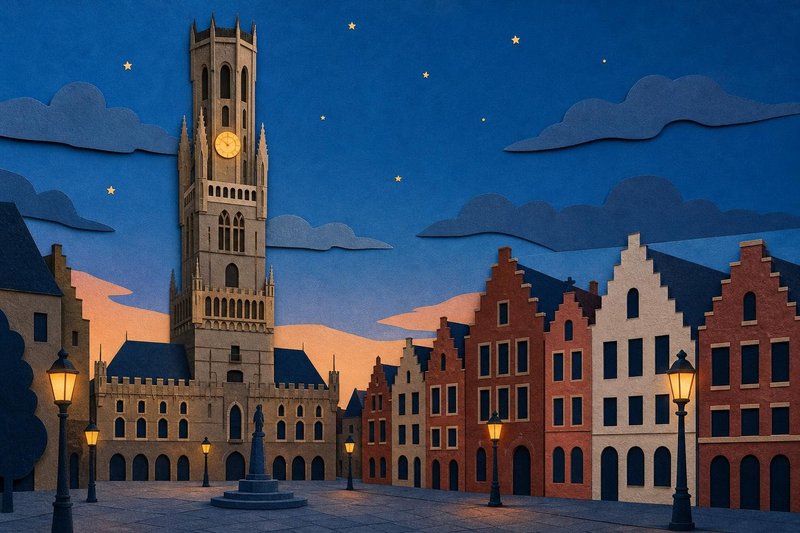
Earth Hour began in Sydney on 31 March 2007, when WWF Australia asked the city to switch off its lights for an hour. Two years later it reached Belgium. Since 2009, on a Saturday evening at the end of March, from 20:30 to 21:30, Belgian households, schools, companies and town halls switch off what they do not need. The landmarks make the headlines: the Atomium, the Grand-Place in Brussels, Antwerp’s cathedral, Ghent’s monuments.
Six moments from the Belgian timeline
-
2009
The first Belgian edition
193 towns and municipalities and 329 companies took part on Saturday 28 March. The grid operator Elia measured a drop of about 400 MW, the average use of 500,000 households, and motorway lighting went off for the hour.
-
2010
The dark side, for once
More than 300 municipalities and 550 companies joined; the Atomium, the Koekelberg basilica and the Grand-Place went dark. Elia measured consumption 2 to 3% below a normal Saturday evening. That year’s Belgian campaign film, a parody of a famous science-fiction villain, travelled far beyond Belgium.
-
2015
Ghent switches off 90 monuments
In Brussels the Atomium and the city hall went dark; Ghent switched off the lighting of more than 90 monuments.
-
2022
38 buildings in Antwerp
Antwerp switched off 38 public buildings and monuments, including the town hall, Het Steen and the cathedral.
-
2026
The twentieth edition
On Saturday 28 March the Atomium, the Grand-Place and Brucity went dark, and a free silent disco took over the Bourse.
-
2027
Next: Saturday 20 March
In 2027 the hour moves a week earlier because 27 March is Easter Saturday: Saturday 20 March 2027 at 20:30, still on winter time.
What the grid saw
Two measurements by Elia, Belgium’s high-voltage grid operator, frame the early years: a drop of about 400 MW in 2009, and consumption 2 to 3% below a normal Saturday evening in 2010, with a peak reduction of 380 MW and no disruption to the grid. In a single home the saving is small, a few cents. The point of the hour is visibility: sixty minutes in which a street can see how much light it leaves on without thinking.
Taking part on 20 March 2027
There is nothing to sign up for. At 20:30 you switch off the lights and the devices you do not need, and at 21:30 you switch them back on. The fridge, the freezer, the heating and anything medical stay on. Belgian families tend to turn the hour into a small event: a cold dinner by lantern light, shadow puppets on a bedsheet, a walk round the block to count the dark windows.
If you are visiting Brussels that evening, the Grand-Place is the place to be. The town hall and the lit façades around the square go dark, and in recent years the square has hosted something extra, from a fire show in 2025 to a silent disco at the Bourse in 2026.
Schools and youth movements often prepare the week before, and some towns announce their plans in the local press. The French and Dutch pages on this site carry a free printable kit with a star chart calculated for Brussels that evening.
Beyond one hour
Light pollution affects the whole country. According to the 2016 world atlas of artificial night sky brightness, 86.8% of Belgians can no longer see the Milky Way from where they live, and the Milky Way is hidden over 51.1% of Belgian territory. Wallonia now switches off central-reservation motorway lighting between 22:00 and 05:00, and in November 2025 the Semois valley became the first Belgian area with the French “starry villages” label.
The full timeline, the map of municipalities, the lights-out meter and a free printable kit with a star chart for 20 March 2027 are available in French and Dutch: start at the French hub or the Dutch hub.
Frequently asked questions
When is Earth Hour 2027 in Belgium?
Saturday 20 March 2027, from 20:30 to 21:30 local time. It is usually the last Saturday of March, but in 2027 that day is Easter Saturday.
Does switching off for an hour save much energy?
Not much in a single home: six LED bulbs, a TV and a games console switched off for an hour save about 0.35 kWh, roughly 13 euro cents at Belgian household prices. The interactive meter on this site shows the detail.
Is this site available in French and Dutch?
Yes. Everything is published in French and Dutch; this English page summarises the Belgian story.
Do I need to register to take part?
No. Switching off is all it takes; there is no form and no list to join. Towns that take part usually announce it themselves.
Updated